
Best Places to Retire in Florida Without Hurricanes
 by Grant Marsten - November 2024
Florida has long been one of America's most popular retirement destinations. Warm weather, beaches, recreational opportunities, established retirement communities and no state personal income tax make the state attractive to many retirees.
But there is a catch: Florida is also one of the most hurricane- exposed states in the country. If you love Florida but would rather reduce your exposure to coastal storm surge, an inland retirement location may be worth considering.
The important distinction is that there is no truly hurricane-free place in Florida. Moving inland can reduce storm-surge exposure, but hurricanes can still bring damaging winds, heavy rain, inland flooding and power outages. The goal is therefore not to eliminate hurricane risk, but to choose a location where the type and severity of risk better matches your retirement priorities.
Florida remains particularly attractive to retirees. The U.S. Census Bureau estimates that about 22.8% of Florida's population was age 65 or older in 2025, making retirees a major part of the state's population.
Understanding Florida's Hurricane Risk
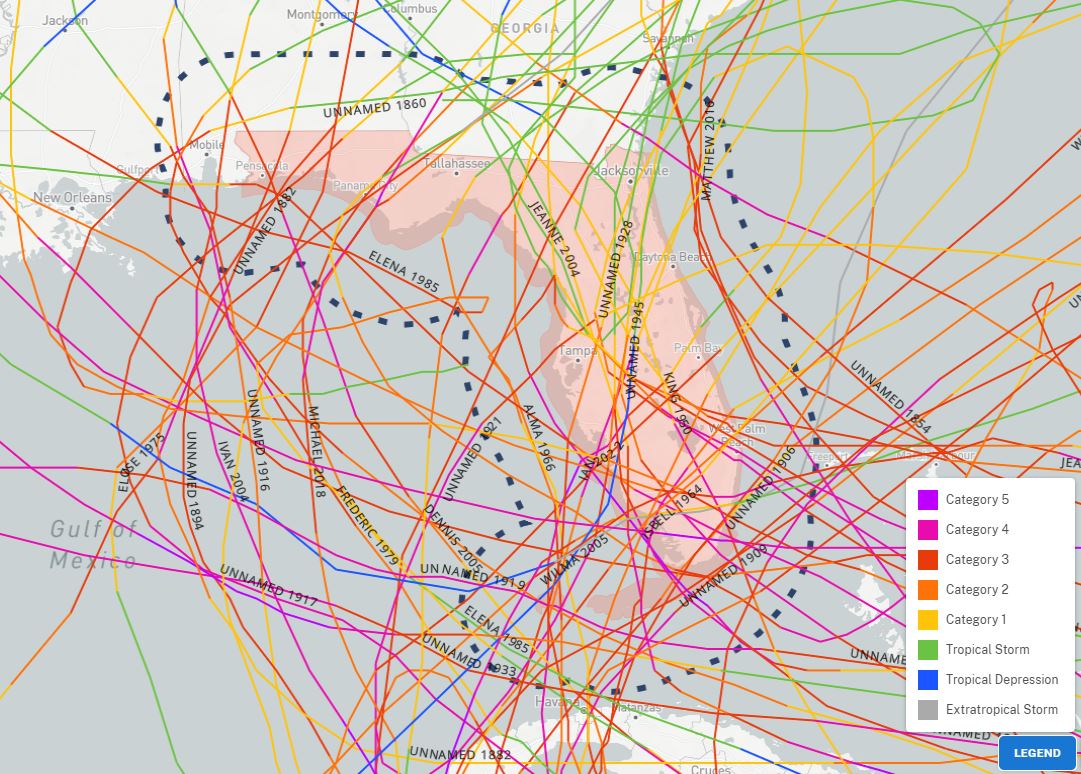
Florida's peninsula places it between the Gulf of Mexico and Atlantic Ocean, exposing different parts of the state to storms approaching from several directions.
Coastal communities face the additional hazard of storm surge. The National Hurricane Center emphasizes that storm surge is not limited to the immediate beachfront and can extend many miles inland depending on the storm and local geography.
That makes the distinction between coastal risk and inland risk important when choosing a retirement location.
What to Consider When Choosing a Location
- Distance from the coast: Greater distance from the coastline can reduce exposure to direct storm surge.
- Elevation: Higher ground can reduce certain flood risks, although elevation alone does not make a property flood-proof.
- Flood zones: Check the specific property's flood risk rather than assuming that an inland city is automatically safe.
- Construction standards: A well-built home with a strong roof, impact-resistant features and appropriate storm protection can be valuable regardless of where you live.
- Emergency services: Look at hospitals, emergency response, evacuation routes and access to essential services.
- Insurance costs: Property, windstorm and flood insurance can have a major impact on your retirement budget.
Why Consider Inland Florida for Retirement?
If your biggest concern is storm surge, moving inland is one obvious strategy. It can also provide other retirement advantages, including potentially lower housing costs than some highly desirable coastal communities.
Inland Florida can also offer access to major metropolitan areas without requiring you to live directly on the coast. That can provide a useful combination of healthcare, shopping, entertainment and outdoor recreation.
However, don't assume that "inland" automatically means "low-risk." Heavy rainfall from tropical systems can produce significant flooding far from the coast, and strong winds can affect communities hundreds of miles from where a hurricane initially makes landfall.
Top Inland Places to Consider for Retirement
The following communities are worth considering if you want Florida's retirement advantages while reducing your exposure to coastal hazards. They should not be interpreted as hurricane- proof locations. Before purchasing a home, investigate the specific property's flood zone, elevation, insurance costs and construction.
1. Ocala
Ocala is one of the better-known inland retirement destinations in central Florida. Located well away from either coastline, it offers a different risk profile from Florida's beachfront communities.
Ocala is particularly attractive to retirees who enjoy outdoor recreation, equestrian activities and a smaller-city environment. The surrounding area is also known for its relatively rolling terrain compared with much of the state.
For retirees, the key consideration is not simply that Ocala is inland. Individual neighborhoods can still have different flood and drainage characteristics, so check the property rather than relying solely on the city name.
2. Gainesville
Gainesville combines an inland location with the amenities of a university city. The presence of the University of Florida contributes to cultural activities, education and healthcare resources.
Its location in north-central Florida also places it farther from the state's major coastal population centers than many popular retirement destinations.
Gainesville can be especially appealing if you want a retirement community that feels like a functioning city rather than a purpose-built retirement development.
3. The Villages
The Villages is one of America's best-known retirement communities and spans parts of several central Florida counties.
Its extensive recreation facilities, golf-cart-friendly communities, clubs and social activities make it attractive to retirees who want an active lifestyle.
Its inland location can reduce exposure to coastal storm surge, but residents should not interpret that as immunity from hurricanes. Tropical systems can still bring strong winds, heavy rain and power disruptions.
4. Orlando
Orlando is not a traditional quiet retirement town, but it can make sense for retirees who prioritize healthcare, restaurants, entertainment, airports and access to a large metropolitan economy.
Orlando's inland position also means it does not face the same direct storm-surge exposure as coastal communities. However, tropical systems can still produce significant rainfall and wind in the Orlando area.
For many retirees, the surrounding suburbs may offer a better balance of convenience, housing and lifestyle than living in the center of the city.
5. Lake City
Lake City, in north-central Florida, offers a smaller-community alternative to places such as Orlando and Gainesville.
Its location away from the immediate coastline may make it appealing to retirees who want to reduce coastal storm-surge exposure while maintaining access to north Florida communities and transportation routes.
As with any Florida location, however, flood risk should be evaluated at the property level before buying.
There Is No Hurricane-Proof Florida City
This is perhaps the most important point in the entire article. Searching for a Florida city that has "no hurricanes" can lead to a false sense of security.
A hurricane that makes landfall on one coast can travel across the state and continue producing damaging weather well inland. Even when wind speeds decrease, rainfall and flooding can remain serious threats.
Instead of asking, "Where in Florida are there no hurricanes?", a better question is: "Where can I find the combination of retirement lifestyle, healthcare, housing costs and manageable storm exposure that works for me?"
How to Evaluate a Florida Retirement Property
Choosing the city is only the first step. Two homes in the same community can have very different levels of risk.
Check the Flood Risk
Don't rely on a real estate listing that simply says "not in a flood zone." Review official flood maps and investigate the property's drainage and elevation.
Review Insurance Before Buying
Insurance can materially change the cost of retirement. Get actual homeowners, windstorm and flood insurance quotes for the property before making a purchase decision.
Look at the Roof and Windows
A newer roof and appropriate storm-resistant construction can make a meaningful difference when severe weather arrives. Consider the home's age, roof condition, windows, garage door and other vulnerable components.
Consider Your Backup Plan
Think beyond the house itself. Ask how you would handle a prolonged power outage, temporary evacuation, medical needs or a major storm that disrupts local services.
Fun Facts About Florida Retirement
- Florida's population was estimated at about 23.5 million in 2025.
- About 22.8% of Florida residents were age 65 or older in 2025.
- Florida does not impose a state personal income tax.
- The state's large retiree population means many Florida communities are designed around healthcare, recreation and retirement-oriented services.
- Being inland does not eliminate hurricane risk. Tropical systems can continue producing wind and flooding well after moving inland.
Planning the Financial Side of a Florida Retirement
Moving to Florida can change more than your weather forecast. It can change your housing costs, insurance, taxes, healthcare expenses, transportation costs and lifestyle spending.
Florida's lack of a state personal income tax can be attractive, but it does not eliminate federal income taxes. Property taxes, insurance, healthcare, transportation and other expenses still need to be incorporated into your retirement plan.
Before moving, compare the complete cost of your proposed Florida lifestyle with your current location. A lower income tax bill does not necessarily mean a lower overall cost of living.
Retirementize can help you model your retirement income, expenses, taxes and long-term financial needs before making a major relocation decision.
Should You Retire in Inland Florida?
Inland Florida can be an excellent compromise for retirees who want the state's warm climate and retirement amenities without living directly on the coast.
Ocala, Gainesville, The Villages, Orlando and Lake City all offer different combinations of lifestyle, healthcare, recreation, housing and access to larger population centers.
But hurricane exposure should be only one part of your decision. Healthcare access, insurance costs, taxes, housing, transportation, family proximity and the kind of retirement you want to live should all be considered.
Conclusion
Florida remains a compelling retirement destination, but there is no location in the state that is completely protected from hurricanes or tropical storms.
If reducing coastal storm-surge exposure is important to you, inland communities such as Ocala, Gainesville, The Villages, Orlando and Lake City are worth investigating. The key is to look beyond the city name and evaluate the specific property, flood risk, insurance requirements and emergency infrastructure.
Most importantly, make the decision as part of your overall retirement plan. The ideal retirement location is not simply the place with the lowest hurricane risk. It is the place where your finances, lifestyle, healthcare needs and personal priorities all work together.
Explore more Retirementize resources, including Retirement Planning Mistakes and How to Retire Happy to help build a retirement plan that fits your goals.