
CoastFIRE Calculator: See How Your Investments Could Coast to Retirement
 by Mark Briggs - September 2026
What if you started investing for retirement when you were 18, contributed aggressively for just a few years, and then allowed your investments to grow for decades?
That is the basic idea behind CoastFIRE.
Rather than assuming you need to keep making retirement contributions throughout your entire working life, CoastFIRE asks whether you can reach a point where your existing investments may be enough to grow into the retirement portfolio you need.
This article walks through a specific example using Retirementize.
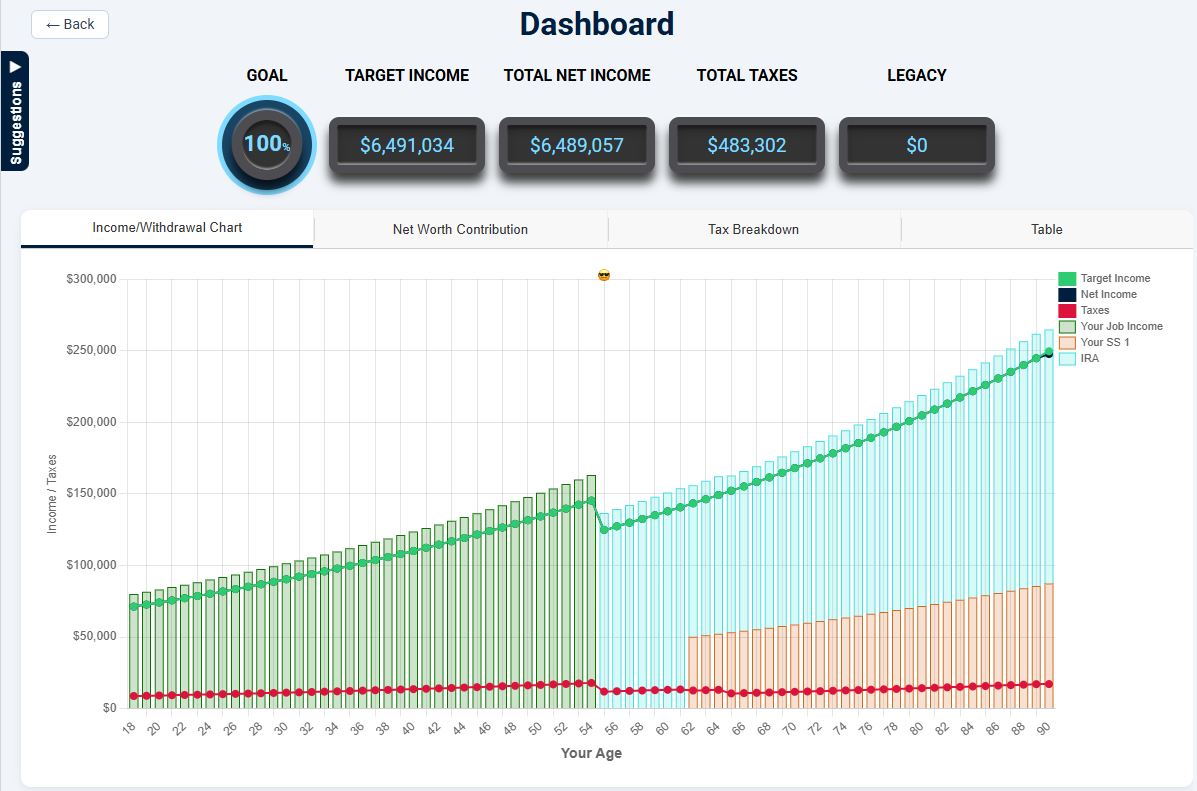
In the example, an 18-year-old starts investing in an IRA, contributes $11,500 per year from age 18 through age 30, and assumes an average investment growth rate of 8%. The investor plans to retire at age 55 with a retirement spending target of $60,000 per year in today's dollars. Social Security of $21,000 per year begins at age 62.
Under these assumptions, the IRA grows to approximately $266,972 by age 30.
The interesting question is what happens after that.
Instead of continuing to contribute to the IRA, the investor can examine whether that age-30 balance could potentially grow for another 25 years and help fund retirement at age 55.
What Is CoastFIRE?
CoastFIRE is a retirement strategy based on the power of compound investment growth.
The basic idea is simple: if you accumulate enough money early enough, you may eventually reach a point where your existing investments can potentially grow to your desired retirement amount without requiring continued contributions.
You do not necessarily stop working when you reach CoastFIRE.
Instead, you may have reached a point where your retirement savings no longer need to be the primary focus of every financial decision. You can continue working and contributing, or you can use some of your income for other priorities.
The earlier you begin investing, the more time your investments have to compound. This can make starting early particularly powerful.
Our CoastFIRE Example
Let's look at one example from beginning to end.
Imagine an 18-year-old who wants to retire at age 55. Rather than waiting until their 30s or 40s to begin investing, they start building their retirement portfolio immediately.
The assumptions are:
- Starting age: 18
- Planned retirement age: 55
- Life expectancy: 90
- Retirement spending target: $60,000 per year in today's dollars
- Inflation assumption: 2%
- Investment growth assumption: 8%
- IRA contributions: $11,500 per year from age 18 through age 30
- Social Security: $21,000 per year beginning at age 62
This is a hypothetical example designed to demonstrate the CoastFIRE concept. Actual investment returns, inflation, taxes, Social Security benefits and future spending can all differ from the assumptions used here.
Step 1: Set the Retirement Spending Target
The first step is to decide what the retirement plan is actually trying to accomplish.
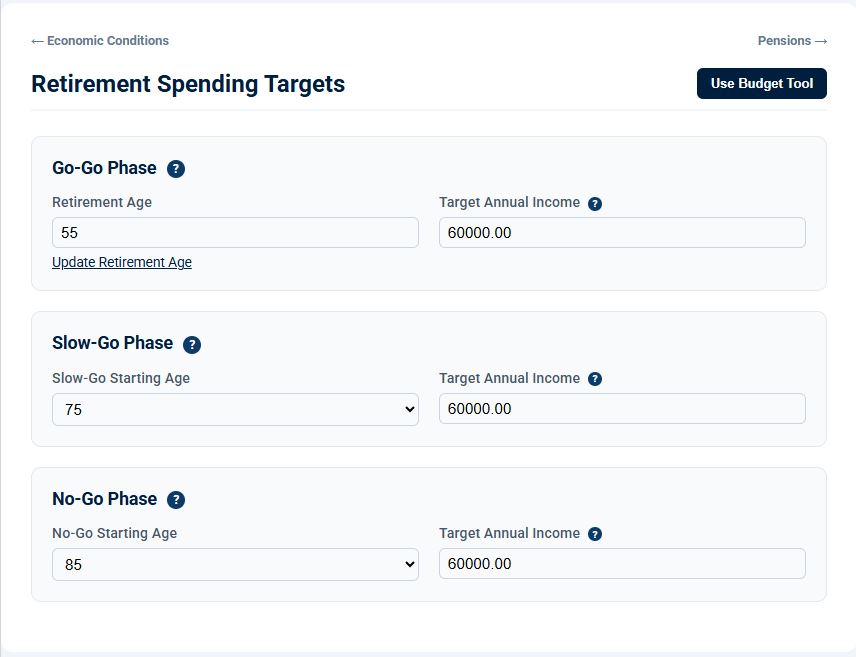
In this example, the investor wants retirement spending of $60,000 per year in today's dollars.
That is an important distinction. A $60,000 spending target today will not necessarily be $60,000 in actual dollars when the investor reaches age 55.
The plan therefore uses an assumed inflation rate of 2% to account for the changing purchasing power of money over time.
Starting with the desired retirement lifestyle gives us something to work toward. We are not simply choosing an investment balance and then trying to determine what kind of retirement it might support.
We are starting with the retirement goal and asking whether the investment strategy can potentially get us there.
Step 2: Create the IRA
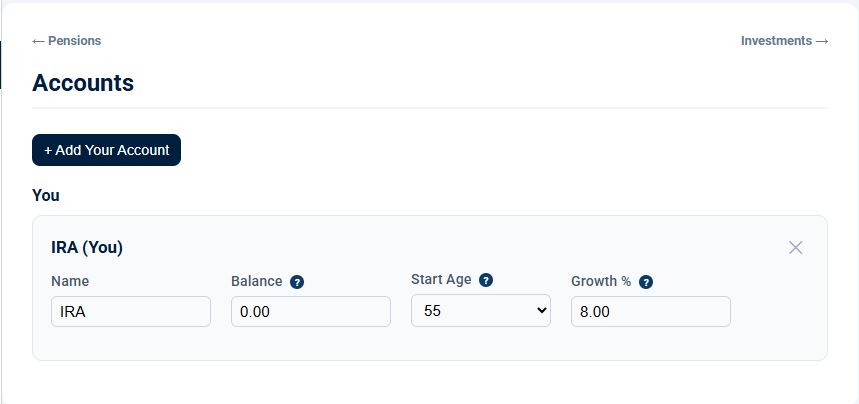
Next, we create the investment account that will be used to build the retirement portfolio.
In this example, that account is an IRA.
The important part of the CoastFIRE strategy is not simply the type of account. It is the combination of the starting age, contributions, investment growth and amount of time available for compounding.
Starting at age 18 gives the investor a very long investment horizon.
Step 3: Contribute From Age 18 to Age 30
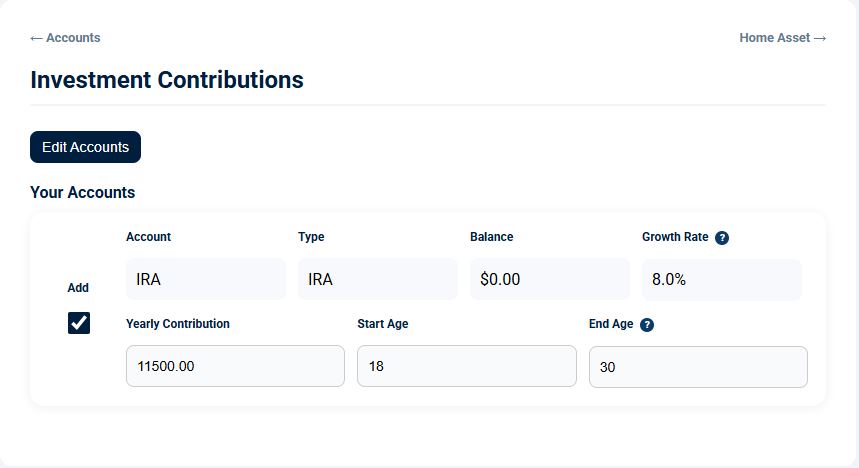
The investor then contributes $11,500 per year to the IRA from age 18 through age 30.
This is the accumulation phase of the example.
During these early years, the investor is actively building the portfolio. The objective is to reach a sufficiently large investment balance early in life so that future investment growth can do more of the work.
The assumed investment growth rate is 8%.
Of course, actual investment returns will not arrive at a steady 8% every year. The 8% figure is simply the assumption used for this example to illustrate the effect of long-term compounding.
Step 4: Set the Retirement Timeline
The next step is to establish how long the retirement plan needs to run.
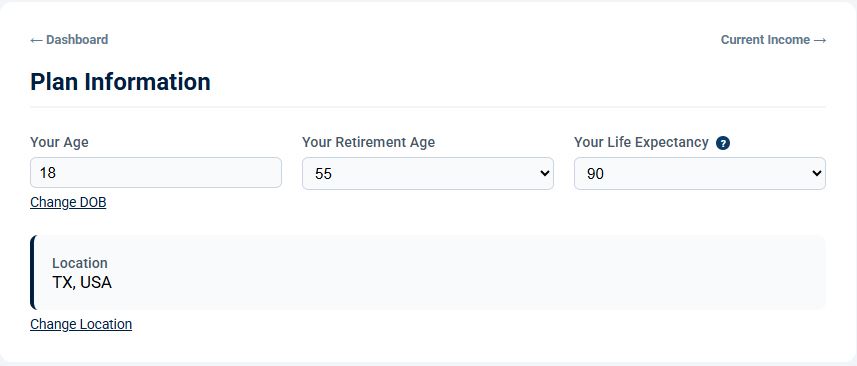
In this example, the investor is currently 18, plans to retire at age 55, and uses a life expectancy of age 90.
This creates two very different periods in the plan.
From age 18 to 30, the investor is making contributions and building the IRA.
From age 30 onward, the CoastFIRE concept becomes particularly interesting. The investor can examine what happens if the IRA is allowed to continue growing rather than assuming another 25 years of contributions.
The investor still has 25 years between age 30 and the planned retirement age of 55.
The CoastFIRE Moment: Age 30
Now we get to the heart of the example.
After contributing $11,500 per year during the early years, the investor reaches approximately $266,972 in the IRA at age 30.
At this point, we can ask the CoastFIRE question:
What happens if the investor stops making contributions and simply allows the IRA to grow until age 55?
This is very different from starting with a lump sum at age 30 and asking whether it is enough.
The $266,972 is the result of an investment strategy that began at age 18. The investor used the early years to build a portfolio and then reached a point where the portfolio could potentially have a long period of growth ahead of it.
That is the essence of CoastFIRE.
What Happens Between Age 30 and 55?
This is where compound growth becomes particularly important.
If the investor stops contributing at age 30, the portfolio does not stop working.
Assuming the 8% investment growth assumption continues, the approximately $266,972 balance has another 25 years to grow before the planned retirement at age 55.
There are no additional contributions required for this part of the illustration. The portfolio is simply allowed to compound.
This is why starting early can have such a significant effect on a CoastFIRE strategy. The investor is using time as part of the retirement plan.
The CoastFIRE milestone in this example is therefore not simply "having $266,972."
It is reaching that investment balance at age 30, with a planned retirement at age 55 and the assumptions used in the model.
Social Security Changes the Retirement Picture
The retirement plan does not assume that the IRA has to provide all of the retirement income.
In this example, the investor expects approximately $21,000 per year of Social Security beginning at age 62.
That creates an additional source of retirement income after age 62.
The first seven years of retirement, from age 55 through age 61, are different because Social Security has not yet started. The IRA may therefore need to provide more of the retirement income during those years.
Once Social Security begins at age 62, the amount of retirement income that needs to come from the investment portfolio can change.
This is one reason a complete retirement model can provide more information than a simple CoastFIRE formula based only on a target portfolio value.
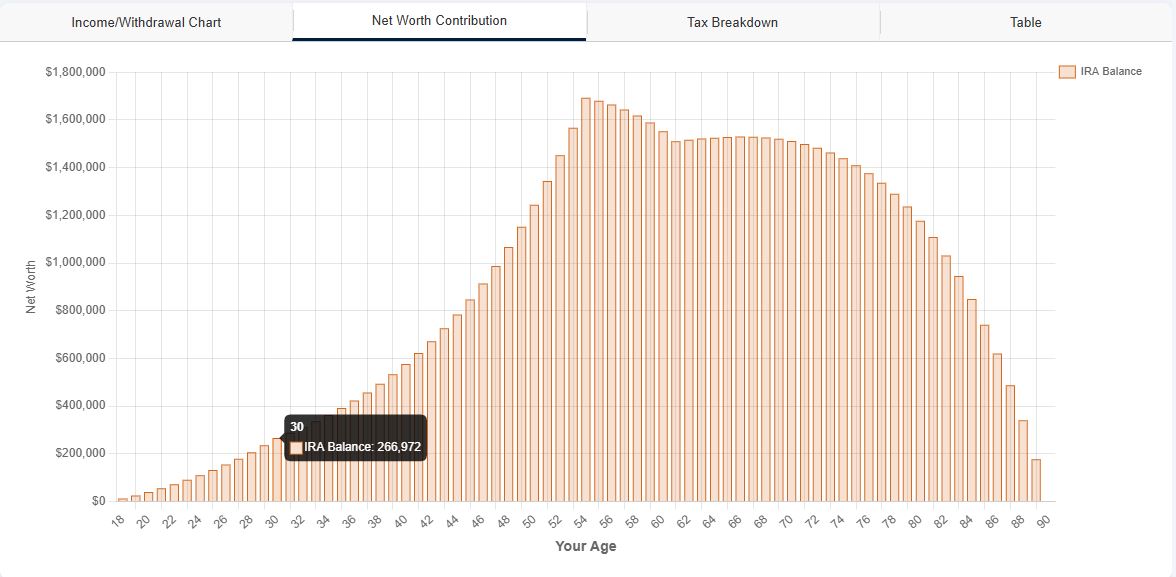
Seeing the $266,972 CoastFIRE Balance
The net worth projection provides another way to visualize what is happening.
By age 30, the IRA balance in this example reaches approximately $266,972.
That number is significant because it represents the end of the aggressive contribution phase of the example.
From there, the investor can examine what happens if no additional IRA contributions are made and the investment is allowed to grow toward the planned age-55 retirement.
Why Age 30 Is So Important in This Example
The age-30 milestone illustrates an important feature of CoastFIRE: the timing of the investment can be just as important as the amount.
Consider two investors with the same $266,972 balance.
One reaches that balance at age 30. The other reaches it at age 50.
They have the same amount of money, but they do not have the same CoastFIRE position.
The investor with the age-30 balance has another 25 years before the planned retirement at age 55. The investor who reaches the same balance at age 50 has only five years.
Time can therefore be a major part of the CoastFIRE equation.
CoastFIRE Is Not the Same as Retiring at 30
An important distinction is that reaching a CoastFIRE milestone does not mean the investor can necessarily retire at that age.
In this example, the investor reaches the potential CoastFIRE point around age 30, but the planned retirement age is still 55.
The investor may continue working for another 25 years.
What changes is the role of additional retirement contributions.
Before age 30, contributions are an important part of building the portfolio.
After reaching the CoastFIRE milestone, the investor can examine whether continued contributions are necessary to meet the original retirement objective under the assumptions in the plan.
They may still choose to contribute more. Doing so could provide additional flexibility, support an earlier retirement, increase future spending or provide a larger margin for unexpected changes.
CoastFIRE simply creates another option to consider.
What Could You Do After Reaching CoastFIRE?
Reaching a projected CoastFIRE point can change how you think about your working years.
You might continue working exactly as before and keep contributing.
Or you might decide that retirement savings no longer need to consume as much of your income.
Depending on your circumstances, you could potentially:
- Work fewer hours.
- Change careers.
- Take a lower-paying job that you enjoy more.
- Take a career break.
- Spend more on travel or hobbies.
- Save for other financial goals.
- Continue contributing and potentially retire earlier.
The important idea is that reaching CoastFIRE can give you more flexibility in how you allocate future income.
Why Use a Full Retirement Calculator?
A simple CoastFIRE calculation can estimate how an investment balance might grow over time.
Retirement planning, however, involves more than investment growth.
In this example alone, we have to consider:
- Retirement spending
- Inflation
- Investment growth
- IRA contributions
- The planned retirement age
- The length of retirement
- Social Security
- Retirement withdrawals
A full retirement model allows these factors to be considered together rather than treating the CoastFIRE target as an isolated portfolio calculation.
CoastFIRE Depends on Your Assumptions
The age-30 result in this example is not a universal CoastFIRE number.
Change the assumptions and the result can change.
For example, a different retirement spending target could require a different investment balance. A different retirement age would provide a different amount of time for the portfolio to grow. A different investment return assumption would also change the projection.
Inflation matters as well. The $60,000 target is expressed in today's dollars, so the amount required in actual future dollars will be higher if inflation occurs as assumed.
Social Security also affects the plan because it provides another source of income beginning at age 62.
This is why a CoastFIRE age should be viewed as an estimate based on a set of assumptions rather than a guaranteed financial milestone.
What If the Investor Keeps Contributing?
CoastFIRE does not require you to stop saving.
In our example, the investor contributes $11,500 per year until age 30. Reaching approximately $266,972 at age 30 provides a useful point from which to examine the CoastFIRE strategy.
But the investor could continue contributing beyond age 30.
Additional contributions could potentially create more flexibility in the retirement plan. They could provide a larger portfolio, allow for higher spending, reduce reliance on future investment growth or support an earlier retirement.
CoastFIRE is therefore not a rule that says, "Stop investing at age 30."
It is a way of asking whether continued contributions are still necessary to achieve a particular retirement goal under the assumptions being modeled.
How to Use Retirementize to Explore CoastFIRE
The example above demonstrates a simple way to investigate CoastFIRE using Retirementize.
- Set your retirement spending target. Start with the lifestyle and spending level you want in retirement.
- Create your investment account. Add the IRA or other investment accounts you intend to use.
- Set your contribution period. In this example, contributions are $11,500 per year from age 18 through age 30.
- Set your investment assumptions. This example uses an 8% expected investment growth rate and 2% inflation.
- Set your retirement timeline. The example starts at age 18, retires at age 55 and models through age 90.
- Add other retirement income. The example includes $21,000 per year of Social Security beginning at age 62.
- Examine the projection. Look at the investment balance, income, withdrawals and net worth over time.
The goal is to see how early contributions and long-term investment growth interact with the retirement lifestyle you want.
CoastFIRE Is About Using Time
The most interesting part of this example is not simply the approximately $266,972 accumulated by age 30.
It is what that money potentially has 25 years to do.
By starting at age 18, the investor gives the portfolio decades to compound before retirement.
That illustrates one of the fundamental ideas behind CoastFIRE: early investment growth can reduce the amount of future contributions needed to reach a retirement goal.
The longer the investment horizon, the more opportunity there is for investment growth to become a larger part of the eventual retirement portfolio.
Things to Consider Before Declaring CoastFIRE
Investment Returns Are Not Guaranteed
The 8% return used in this example is an assumption. Actual investment returns can be significantly different from a smooth annual growth rate.
Inflation Matters
The example uses 2% inflation. If inflation is higher or lower than assumed, the amount required to maintain a particular lifestyle can change.
Taxes Matter
Investment account balances and spendable retirement income are not necessarily the same thing. Tax treatment can affect how much money is available to spend.
Your Retirement Goal Can Change
A retirement plan created at age 18 may look very different by age 30, 40 or 50.
Your desired lifestyle, housing situation, family circumstances, spending and retirement age can all change.
Government Benefits Can Change the Plan
Retirement income does not necessarily have to come entirely from investments.
Government benefits such as Social Security, CPP or OAS, as well as employer pensions, can affect how much income needs to be generated from investments.
CoastFIRE Is a Starting Point, Not a Guarantee
The example demonstrates how CoastFIRE can work, but it is important not to treat a projected CoastFIRE age as a guarantee.
An investment projection is only as reliable as the assumptions behind it. Markets do not produce a predictable return every year, inflation can vary, retirement spending can change and government benefits may differ from initial estimates.
This is why it can be useful to revisit your retirement plan as your circumstances change.
If your investment balance grows faster than expected, you may reach your target earlier. If returns are lower, you may need to contribute longer or adjust your retirement plans.
Conclusion
CoastFIRE is fundamentally about giving your investments enough time to work for you.
In our example, an 18-year-old starts investing $11,500 per year in an IRA, assumes 8% investment growth and contributes through age 30. The resulting IRA balance is approximately $266,972 at age 30.
The investor then has another 25 years before the planned retirement at age 55.
The retirement goal is $60,000 per year in today's dollars, with 2% inflation and $21,000 of Social Security beginning at age 62.
The CoastFIRE question is whether the investment balance reached early in life can potentially grow sufficiently to support that future retirement plan without relying on continued aggressive contributions.
That is what makes CoastFIRE such an interesting retirement-planning concept. Instead of focusing only on how much you need to save every year until retirement, you can examine how early investment, time, growth and your eventual retirement goals work together.
Retirementize lets you build that broader picture by combining investment accounts, retirement goals, inflation, retirement income, withdrawals and retirement timing in one plan.
Want to explore your own CoastFIRE scenario? Try Retirementize and see how your investment timeline could affect your path toward retirement.
