
Can I Retire at 60 with $500K?
 by Mark Briggs - August 2025
If you've saved $500,000 and are asking yourself, "Can I retire at 60 with $500K?", the answer is: potentially, yes—but it depends heavily on your spending, other sources of income, taxes, investment returns, healthcare costs, and how long your money needs to last.
There is no universal income number that $500,000 can safely provide. A retiree who spends $30,000 a year may have a very different outcome from someone spending $60,000. Likewise, someone with a pension or substantial Social Security benefit has a very different starting position from someone relying almost entirely on their portfolio.
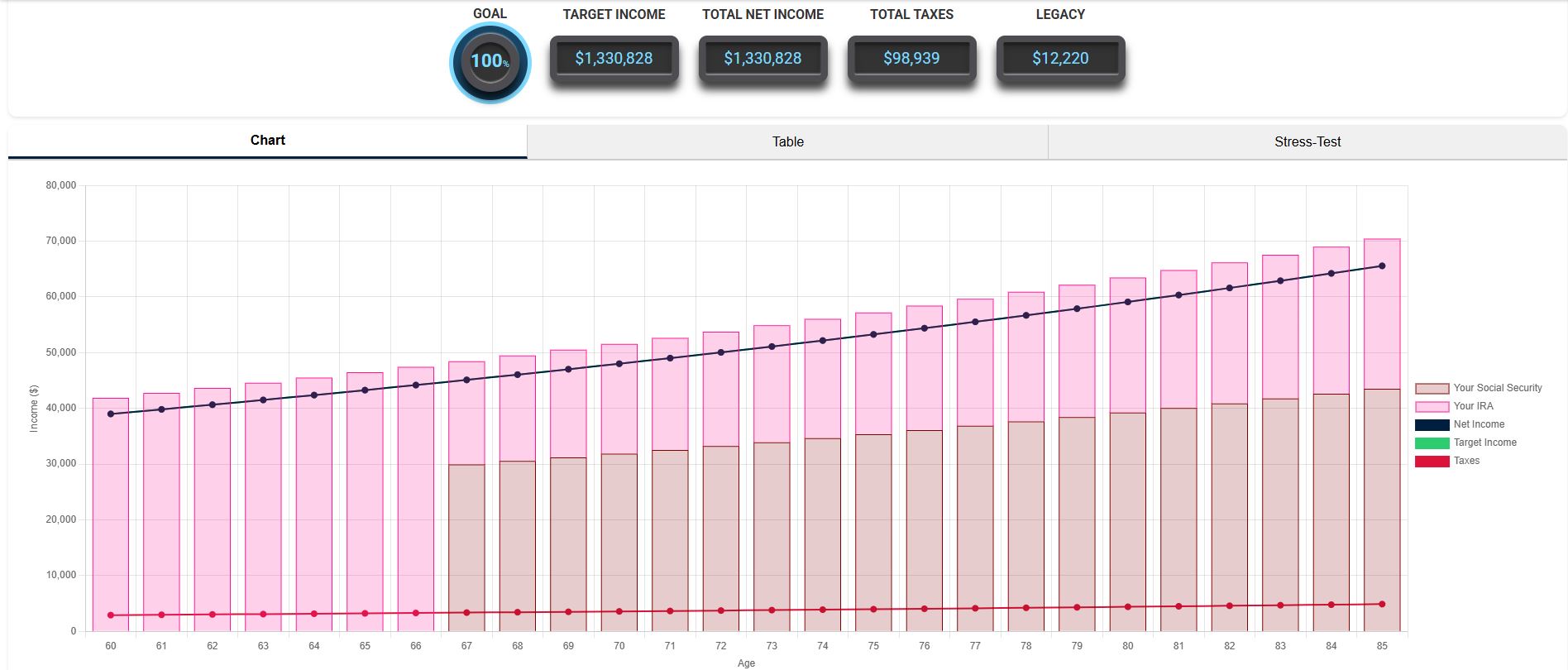
In the Retirementize example illustrated below, a single retiree starts with $500,000 at age 60 and combines portfolio withdrawals with Social Security. Under the assumptions used in that example, the modeled income is approximately $39,000 per year through age 85. However, this is a specific planning scenario—not a guarantee. Changing the retirement age, spending level, investment return, inflation, Social Security benefit, taxes, or life expectancy can materially change the result.
Understanding the Retirement Math
When you retire, your spending is generally funded by some combination of investment withdrawals, Social Security, pensions, rental income, part-time work, and other sources.
A commonly discussed guideline is the 4% rule. Under the traditional version, a retiree withdraws approximately 4% of their initial portfolio in the first year and then adjusts the dollar amount for inflation. With a $500,000 portfolio, that would mean a first-year withdrawal of approximately $20,000.
However, the 4% rule should not be treated as a guarantee. More recent retirement-income research suggests that sustainable starting withdrawal rates can vary depending on investment returns, inflation, asset allocation, retirement length, and whether a retiree is willing to adjust spending when markets perform poorly. For a 30-year retirement, Morningstar's 2025 research estimated a 3.9% starting rate under its conservative base-case assumptions.
For a $500,000 portfolio, a 3.9% starting withdrawal would be approximately $19,500 in the first year, before taxes. Add Social Security and the total household income can be considerably higher—but the exact result depends on the individual's actual Social Security benefit and when they begin claiming it.
The Retirementize Example
The example shown in the graph uses the following assumptions:
- Starting retirement age: 60
- Life expectancy: 85
- Household: Single
- Starting savings: $500,000
- Inflation: 2.1% annually
- Investment growth: 4%
- Social Security: approximately $1,860 per month in the original model
- Location assumption: a state without individual income tax
Because this is an illustrative model created using historical assumptions, it should be viewed as an example rather than a prediction. Your own retirement plan should use your actual Social Security estimate, expected spending, tax situation, investment portfolio, and desired life expectancy.
The Role of Social Security
Social Security can be a major part of the equation for someone retiring at 60. The important point is that retiring at 60 does not mean you have to claim Social Security at 60.
For most people, Social Security retirement benefits can begin as early as age 62. Claiming before Full Retirement Age permanently reduces the monthly benefit. Waiting beyond Full Retirement Age can increase the benefit until age 70.
The amount you receive depends on your earnings history and claiming age. In January 2025, the average monthly benefit for retired workers was approximately $1,979, although individual benefits vary substantially.
That means you should not automatically use the national average when building your own retirement plan. Instead, check your personal Social Security estimate and model different claiming ages.
Learn more in our article: What Is Social Security?
Should You Claim Social Security at 62?
Not necessarily.
If your $500,000 portfolio can support your spending for several years, you may have the option of delaying Social Security. Waiting can result in a larger monthly benefit later, which can be especially valuable if you live well into your 80s or 90s.
On the other hand, claiming earlier can reduce the amount you need to withdraw from your portfolio. The right decision depends on your health, longevity expectations, marital status, tax situation, spending needs, and other sources of income.
This is one reason retirement planning should compare multiple Social Security claiming strategies rather than automatically choosing age 62 or 67.
How Far Does $500K Go?
The answer depends primarily on how much you spend.
For example, consider a simplified starting withdrawal of 4% from $500,000. That produces approximately $20,000 of first-year portfolio income. A retiree receiving $24,000 per year from Social Security would then have approximately $44,000 of gross income before taxes.
But this doesn't mean $44,000 is guaranteed for life. Investment returns fluctuate, inflation changes purchasing power, taxes reduce spendable income, and unexpected expenses can require additional withdrawals.
Someone retiring at 60 also faces a potentially long retirement. A person who lives to 95 could spend 35 years in retirement. That is considerably different from a plan designed to age 85.
That's why life expectancy is one of the most important assumptions in any retirement plan. Tools like the Retirement Withdrawal Calculator can help you explore different scenarios.
Where Should the $500K Be Invested?
How you invest your $500,000 can be just as important as how much you have saved. The goal isn't simply to chase the highest possible return. Your portfolio needs to balance growth, income, liquidity, and risk.
Scenario A: Conservative
A conservative portfolio might allocate a larger portion to high-quality bonds, GICs, CDs, or other fixed-income investments, while maintaining some exposure to stocks for long-term growth.
This approach can reduce volatility, but excessive conservatism creates another risk: your investments may not grow fast enough to keep pace with inflation over a long retirement.
Scenario B: Balanced Growth
A balanced portfolio could combine diversified stock index funds with bonds and a cash reserve. For example, an investor might use a mix of approximately 60% diversified equities, 30% bonds, and 10% cash.
The exact allocation should depend on your risk tolerance, time horizon, other income sources, and ability to tolerate market declines.
Scenario C: Income-Focused
Some retirees prefer investments designed to generate regular income, such as dividend-paying stocks, bonds, REITs, or other income-producing assets.
However, income should not be confused with safety. A high dividend yield does not automatically mean an investment is low-risk, and concentrating too heavily on income-producing assets can reduce diversification.
Scenario D: Partial Annuity
Another option is to use part of the portfolio to purchase an annuity that provides guaranteed lifetime income while keeping the remainder invested for flexibility.
Annuities can be useful in some retirement plans, but they come with trade-offs involving fees, liquidity, inflation protection, guarantees, and the financial strength of the insurer.
Learn more in our article What Is an Annuity?.
Lifestyle Choices That Matter
Income is only one side of the retirement equation. Spending is the other.
A retiree with a paid-off home, modest transportation costs, low healthcare expenses, and limited travel may be able to live comfortably on considerably less than someone paying rent or a mortgage while traveling extensively.
Consider these expenses when determining whether $500K is enough:
- Housing and mortgage costs
- Property taxes and home maintenance
- Healthcare and insurance premiums
- Transportation and vehicle replacement
- Travel and entertainment
- Food and household expenses
- Support for children or other family members
- Taxes
- Long-term care and other unexpected expenses
Check out our guide on Frugal Retirement for ideas on how to make your retirement dollars go further.
Healthcare: The Big Expense Before Medicare
One of the biggest challenges for someone retiring at 60 is healthcare.
Medicare generally begins at age 65, which means someone retiring at 60 needs to plan for approximately five years of healthcare coverage before Medicare eligibility. That may involve employer retiree coverage, a spouse's plan, private insurance, or coverage through the Affordable Care Act marketplace, depending on the individual's circumstances.
Healthcare costs can vary dramatically from one retiree to another, so they should be included explicitly in your retirement budget rather than treated as an afterthought.
What Happens If You Live Longer?
Longevity is one of the biggest risks in retirement planning.
A plan that looks comfortable through age 85 can look very different if you live to 90, 95, or 100. The longer your retirement lasts, the more important investment returns, inflation, healthcare costs, and spending flexibility become.
Living longer isn't a bad problem to have—but your retirement plan needs to be designed with longevity in mind.
Risks to Watch Out For
- Sequence-of-returns risk: Large market losses early in retirement can permanently damage a portfolio because you're withdrawing money while the investments are declining.
- Inflation: Higher-than-expected inflation can significantly reduce your purchasing power over a long retirement.
- Healthcare costs: Retiring before Medicare eligibility creates an additional period of healthcare uncertainty.
- Longevity: Living longer than expected means your savings need to last longer.
- Unexpected expenses: Home repairs, vehicle replacement, family support, long-term care, and other expenses can require larger withdrawals.
- Taxes: The amount you withdraw isn't necessarily the amount you get to spend. Your account types and withdrawal strategy can have a major effect on after-tax income.
Strategies to Strengthen Your Plan
- Delay Social Security: If your finances allow it, delaying benefits can increase your eventual monthly income.
- Work part-time: Even a few years of part-time income can reduce withdrawals during the early years of retirement.
- Consider rental income: Rental properties can provide another source of retirement cash flow, although they also come with costs and management responsibilities. See Rental Properties for Retirement Income.
- Consider Roth conversions: The years between retirement and Required Minimum Distributions may create opportunities for tax planning. See What Is an RMD?.
- Downsize: Selling a large home and moving to a lower-cost property can potentially reduce housing expenses and unlock home equity.
- Relocate: Moving to a lower-cost region may reduce housing, taxes, and everyday expenses. See Least Expensive States to Retire In.
- Maintain flexibility: Being willing to reduce discretionary spending after poor investment years can improve the longevity of your portfolio.
Fun Facts
- $500,000 at 4%: A 4% initial withdrawal from a $500,000 portfolio is $20,000 in the first year.
- Social Security varies widely: In January 2025, the average monthly benefit for retired workers was approximately $1,979, but individual benefits depend on earnings history and claiming age.
- Medicare doesn't start at 60: For most people, Medicare eligibility begins at age 65, creating a potentially important five-year healthcare-planning gap for someone retiring at 60.
- The 4% rule isn't a promise: Current retirement-income research considers withdrawal rates closer to 4%—and sometimes lower—depending on assumptions about portfolio returns, inflation, retirement length, and spending behavior.
- Five extra years matter: A retirement plan designed to age 85 has a very different risk profile from one designed to age 95 or 100. Longevity is one of the most important variables in retirement planning.
Can You Retire at 60 With $500K?
Yes, it can be possible—but $500,000 is not automatically enough.
The deciding factor isn't simply the size of your portfolio. It's the relationship between your assets, spending, income sources, taxes, healthcare costs, investment strategy, and longevity.
Someone with a paid-off home, modest spending, Social Security, and flexible expenses may be able to make $500K work. Someone with high housing costs, significant travel plans, expensive healthcare needs, or a desire to leave a large inheritance may need considerably more.
The original Retirementize example illustrates how a $500,000 portfolio combined with Social Security can potentially support a modest retirement income. But the most important lesson is that your numbers are what matter.
Conclusion
So, can you retire at 60 with $500K? Possibly—but you'll need a thoughtful plan.
Retiring at 60 means your savings may need to support you for several decades. That makes spending discipline, investment diversification, Social Security timing, healthcare planning, taxes, and longevity especially important.
You don't necessarily need to wait until you've accumulated a million dollars before retirement becomes possible. But you do need to understand exactly how your $500,000 interacts with the rest of your financial picture.
Rather than asking only, "Is $500K enough?", ask a better question: "What kind of retirement can $500K support for me?"
The answer can change dramatically depending on when you claim Social Security, how much you spend, where you live, how your portfolio performs, and how long you live.
Use the Retirementize calculator to test your own retirement age, savings, income, spending, Social Security, taxes, and longevity assumptions and see how different decisions affect your projected retirement.
