Retirement Calculators: Savings Accumulation vs. Retirement Income Planning
 by Mark Briggs - September 2024 (Updated August 2026)

Are you saving enough for retirement?
That's one of the first questions most retirement calculators try to answer. But eventually, a more important question takes over:
How do I actually turn my retirement savings into reliable income?
Those are two very different retirement-planning problems. And while the terms "retirement calculator" and "retirement planning calculator" are often used interchangeably, the tools behind those names can work very differently.
There are two broad categories of retirement calculators:
- Retirement savings accumulation calculators — focused primarily on building your retirement nest egg.
- Retirement income planning calculators — focused primarily on turning your assets and income sources into a sustainable retirement plan.
Understanding the difference can help you choose the right tool for the stage of retirement you're in.
Retirement Savings Accumulation Calculators
A retirement savings calculator is primarily designed for the accumulation phase of retirement planning.
If retirement is still several years away, you may be asking questions such as:
- How much should I save each month?
- How much could my investments grow?
- Am I on track for my retirement goal?
- What happens if I increase my savings rate?
- How much will I have when I retire?
An accumulation calculator can be useful for answering these questions because it focuses on the growth of your savings over time.
Many financial institutions, investment companies, financial-planning websites, and personal-finance websites offer calculators designed around this stage.
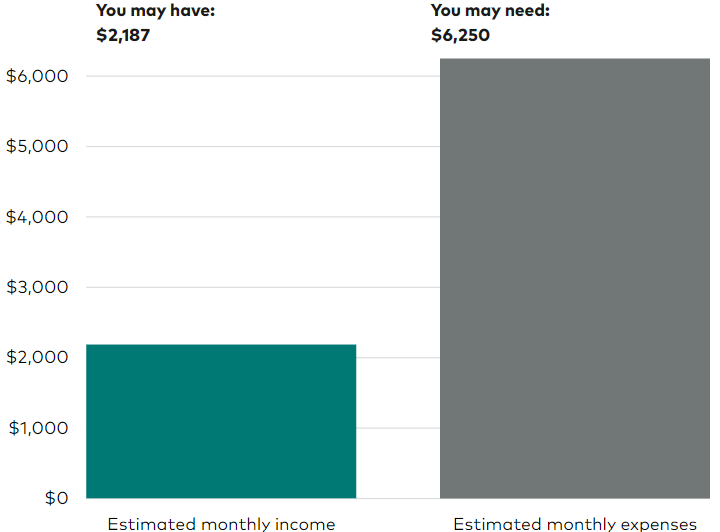
What Does a Savings Accumulation Calculator Typically Show?
Depending on the calculator, you may be able to enter information such as your current age, retirement age, savings balance, annual contributions, and an assumed investment return.
The calculator then projects how your savings might grow.
Common features include:
- Savings and investment projections: Estimate how your retirement balance could change over time.
- Contribution planning: Explore how increasing or decreasing your savings rate could affect your projected retirement balance.
- Progress tracking: Compare your projected savings with a target retirement amount.
- Multiple accounts: Some calculators allow you to combine several investment or retirement accounts.
- Investment return assumptions: Model different assumed rates of return.
- Retirement-age projections: See how changing your expected retirement date affects your projected savings.
- Charts and graphs: Display projected account growth visually.
The Limitation of a Savings Calculator
The biggest limitation is that having a projected retirement balance doesn't necessarily tell you whether you can actually afford the retirement you want.
Suppose a calculator tells you that you'll have $1 million at retirement. Is that enough?
There is no universal answer.
It depends on your spending, taxes, housing costs, pensions, government benefits, investment returns, longevity, inflation, and many other factors.
A $1 million portfolio could support very different lifestyles for two different households.
That's where retirement income planning becomes much more important.
Retirement Income Planning Calculators
A retirement income calculator approaches the problem from the other direction.
Instead of primarily asking:
"How much money will I have?"
it asks:
"How much income can I generate from what I have?"
This distinction becomes particularly important as you approach retirement or transition from saving to spending.
Your retirement income may come from many different sources:
- Employer pensions
- Government benefits
- RRSPs and RRIFs
- TFSAs
- 401(k)s and IRAs
- Taxable investment accounts
- Savings accounts
- Rental properties
- Part-time or consulting income
- Home equity
A useful retirement income plan brings these pieces together and asks whether they can support your desired spending throughout retirement.
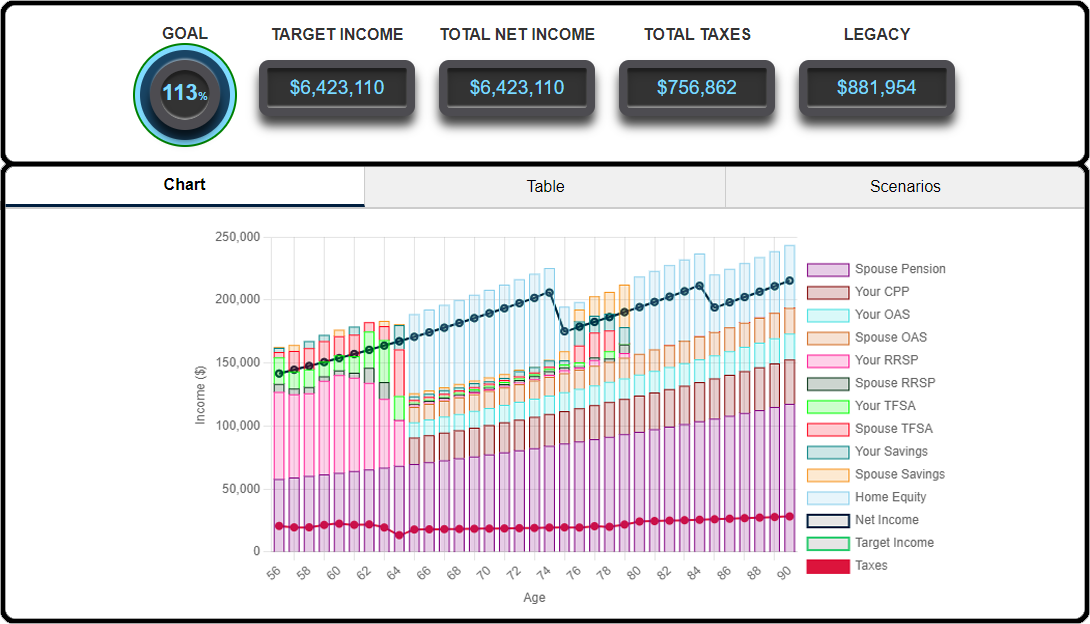
What Should a Retirement Income Calculator Consider?
A more complete retirement income model can consider far more than your investment balance.
1. Multiple Sources of Income
Retirement rarely consists of one account and one withdrawal.
A household might receive a combination of CPP, OAS, Social Security, employer pensions, RRIF withdrawals, investment income, rental income, and other cash flow.
Looking at these sources together can provide a much clearer picture of retirement cash flow.
2. Taxes
A retirement plan should distinguish between gross income and after-tax income.
Two households with identical gross retirement income may have very different amounts available to spend after taxes.
Depending on the country and the accounts involved, retirement income planning may need to consider RRSP/RRIF taxation, IRA and 401(k) withdrawals, Roth accounts, taxable investments, government benefits, and other tax considerations.
3. Withdrawal Strategy
Having several retirement accounts creates another question:
Which account should I use first?
The answer may change over time. A retirement income plan can help you explore different withdrawal strategies rather than assuming every dollar should simply be withdrawn proportionally from every account.
4. Inflation
Retirement could last decades. The purchasing power of today's dollar may be very different later in retirement.
A useful retirement model should therefore allow you to consider inflation and how your spending may change over time.
5. Different Retirement Phases
Retirement spending isn't necessarily constant.
Many retirees spend more on travel, entertainment, hobbies, and other activities during their earlier retirement years. Spending may change as priorities and mobility change later in life.
At Retirementize, we describe these phases as:
- Go-Go Years: The active years of retirement.
- Slow-Go Years: A period when spending and activity may begin to moderate.
- No-Go Years: Later retirement, when lifestyle and spending may look very different.
Building these phases into a retirement plan can produce a more realistic picture than assuming the same spending level from retirement until death.
6. Real Estate
Your home may be one of your largest assets, but that doesn't necessarily mean it produces retirement income.
A comprehensive retirement plan can distinguish between your primary residence, rental properties, mortgages, and other real-estate assets.
Depending on your situation, you might eventually sell a property, downsize, rent it out, pay down a mortgage, or simply continue living in your home.
7. Longevity
Retirement planning needs to account for the possibility of living a long life.
A plan that works if you live to 85 may look very different from one that needs to support you to age 95 or beyond.
8. What-If Scenarios
Retirement doesn't always follow the original plan.
What happens if:
- You retire earlier than expected?
- You work several years longer?
- Your investment returns are lower?
- You spend more on travel?
- You receive an inheritance?
- You help your children financially?
- You sell your home?
- You experience a major unexpected expense?
- One spouse dies earlier than expected?
These scenarios are often more useful than a single "perfect" retirement projection.
Retirement Savings Calculator vs. Retirement Income Calculator
So which one do you need?
The answer depends largely on where you are in your retirement journey.
| Feature | Savings Accumulation | Retirement Income Planning |
|---|---|---|
| Primary goal | Build retirement savings | Turn assets into sustainable income |
| Best suited for | People still accumulating wealth | People approaching or in retirement |
| Account growth | Core feature | Important |
| Taxes | May be limited | Important consideration |
| Withdrawal strategy | Usually limited | Core feature |
| Pensions and government benefits | May be limited | Can be integrated into the plan |
| Retirement spending | Usually estimated | Central to the analysis |
| Multiple retirement phases | Usually limited | Can be incorporated |
| What-if scenarios | Often limited | Important planning feature |
When Should You Switch From Savings Planning to Income Planning?
You don't necessarily need to choose one type of calculator and ignore the other.
In fact, they can complement each other.
Early in your career, your primary focus may be accumulating assets. Your biggest levers might be:
- How much you save.
- How long you invest.
- How much you earn.
- How your investments are allocated.
- When you plan to retire.
As retirement approaches, however, the questions start to change.
You may start asking:
- When should I start CPP or Social Security?
- When should I start OAS?
- How much can I safely spend?
- Which accounts should I draw from first?
- How will withdrawals affect my taxes?
- What happens if markets fall shortly after I retire?
- How much money will my spouse have if I die first?
- Can I afford to retire now?
- How much can I leave to my children?
Those are retirement-income questions.
Why Your Retirement Number Isn't Really a Number
One of the biggest problems with focusing exclusively on a retirement savings target is that it can make retirement planning seem like a simple equation:
"Save X dollars and you'll be fine."
Real retirement planning is more complicated.
A retirement portfolio doesn't exist in isolation. It interacts with your spending, taxes, pensions, government benefits, housing, health-related expenses, investment returns, inflation, and longevity.
That's why two people with the same retirement savings balance can have completely different retirement plans.
Which Retirement Calculator Is Right for You?
If you're decades away from retirement and primarily want to know whether you're saving enough, a retirement savings accumulation calculator can be a useful starting point.
If retirement is approaching or you're already retired, a retirement income planning calculator can answer a different and more important set of questions about how your assets and income sources work together.
And if you're somewhere in between, using both approaches can make sense.
The important thing is to understand what question the calculator is actually answering.
How Retirementize Approaches Retirement Planning
Retirementize is designed around the transition from retirement savings to retirement income.
Instead of focusing only on the size of your investment portfolio, Retirementize brings together the different pieces that can affect your retirement plan.
Depending on your circumstances, that can include:
- Retirement accounts and savings.
- Employer pensions.
- CPP and OAS.
- U.S. Social Security.
- Rental properties.
- Your primary residence.
- Retirement spending goals.
- Taxes and government-benefit considerations.
- Different stages of retirement.
- What-if scenarios.
- Long-term retirement projections.
The goal isn't simply to tell you how much money you might have.
The goal is to help you understand how your money could support the retirement you want.
Fun Facts
- A retirement portfolio balance does not automatically tell you how much you can safely spend each year.
- The same retirement savings balance can support very different lifestyles depending on spending and other income sources.
- Retirement planning changes significantly once the focus shifts from accumulating money to withdrawing and spending it.
- Government benefits and employer pensions can be just as important to a retirement-income plan as investment accounts.
- A retirement plan can be tested against different retirement dates, spending levels, investment returns, and other life events.
Final Thoughts
Retirement calculators can be extremely useful, but the usefulness depends on asking the right question.
During the accumulation years, you may primarily want to know:
"Am I saving enough?"
As retirement approaches, the question becomes:
"Can I turn what I've accumulated into the retirement income I need?"
That's a much bigger question.
A comprehensive retirement-income plan should consider not just how much you have, but how much you spend, where your income comes from, how taxes affect that income, how long your money needs to last, and what happens when life doesn't go according to plan.
The best retirement calculator isn't necessarily the one with the biggest number at the end of the projection.
It's the one that helps you understand what that number actually means for your life in retirement.