
Tax-Free Retirement: Patrick Kelly Book Review and Strategy Guide
 by Tracy Gillis - October 2024
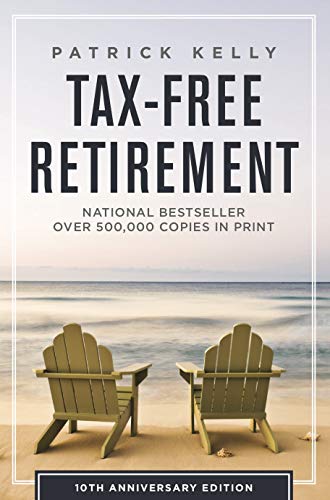
What if you could build part of your retirement income from assets that are designed to receive favorable tax treatment when you use them in retirement?
That is the central idea behind Patrick Kelly's book Tax-Free Retirement. Originally published in 2007, the book focuses heavily on tax diversification and the potential role of cash-value life insurance alongside more familiar retirement accounts. A later 10th Anniversary Edition expanded on the same general approach.
The phrase "tax-free retirement" can sound almost too good to be true. It is important to understand that tax-free does not mean tax-free under every circumstance. Different retirement vehicles have different rules, costs, risks, contribution limits, and tax consequences.
This article looks at the ideas presented in Kelly's book and puts them into the context of modern retirement planning.
What Is Patrick Kelly's Tax-Free Retirement Strategy?
Kelly's approach challenges the idea that retirement savings should be concentrated entirely in tax-deferred accounts such as traditional IRAs and 401(k)s.
With a traditional retirement account, you may receive a tax deduction when money goes in, but withdrawals are generally taxable later. This creates a form of tax deferral rather than permanent tax elimination.
Kelly argues that retirees should also consider assets that can potentially provide tax-free or tax-advantaged income, particularly Roth accounts and properly structured permanent life insurance.
The broader concept is known as tax diversification: rather than having every retirement dollar exposed to the same tax treatment, you build several different types of assets.
Why Tax Diversification Matters in Retirement
Retirement can produce a very different tax situation from your working years. Instead of receiving one paycheck, you may draw income from several sources:
- Traditional IRAs or 401(k)s
- Roth IRAs or Roth 401(k)s
- Taxable investment accounts
- Pensions
- Social Security
- Rental properties
- Cash-value life insurance
These sources do not necessarily receive the same tax treatment.
That gives retirees an opportunity to manage where their retirement income comes from, rather than simply withdrawing money from whichever account has the largest balance.
For example, someone might take some taxable income from a traditional IRA while using Roth assets for another expense. The goal is not necessarily to eliminate every dollar of tax, but to manage the household's overall tax exposure over many years.
Traditional Retirement Accounts Are Tax-Deferred, Not Tax-Free
One of the strongest themes in Kelly's book is the distinction between tax-deferred and tax-free money.
Traditional 401(k)s and IRAs can be extremely useful retirement vehicles. Contributions may receive favorable tax treatment, and investments can grow without current annual taxation on the account's earnings.
But withdrawals from traditional accounts are generally included in taxable income. Required minimum distributions can also force taxable withdrawals later in life.
This does not make traditional retirement accounts bad. It means that they solve a different tax problem from Roth accounts.
Roth IRAs: A More Straightforward Form of Tax-Free Retirement Income
Roth IRAs are one of the clearest examples of the tax-free retirement concept. Contributions are made with after-tax dollars, and qualified withdrawals can generally be received tax-free.
For 2026, the annual contribution limit for traditional and Roth IRAs combined is $7,500, with an additional $1,100 catch-up contribution available to eligible individuals age 50 or older. Income limits can reduce or eliminate the ability to contribute directly to a Roth IRA.
Roth IRAs therefore offer an important form of tax diversification, but they are subject to contribution and qualification rules. Simply putting money into a Roth account does not make every subsequent distribution automatically tax-free.
The Role of Cash-Value Life Insurance
This is where Kelly's strategy becomes more distinctive.
The book focuses extensively on permanent, cash-value life insurance. Unlike term life insurance, permanent policies can accumulate cash value while also providing a death benefit.
Depending on the policy, premiums paid, investment or crediting performance, fees, withdrawals, and policy loans, the cash value may become a source of funds that can supplement retirement income.
Kelly's strategy is based on building cash value and then accessing that value rather than simply treating the policy as a traditional investment account.
However, this strategy requires considerably more care than the phrase "borrow tax-free" suggests.
Why Policy Loans Are Not Simply Free Money
A policy loan is generally a loan secured by the policy's cash value. The money still has to be accounted for, interest can accumulate, and an outstanding loan can reduce the policy's death benefit and cash value.
If a policy is poorly funded, allowed to lapse, or otherwise fails to remain in force, the tax consequences can be very different from the intended strategy.
Anyone considering life insurance as a retirement-income vehicle should therefore review the policy's guaranteed values, non-guaranteed assumptions, loan provisions, fees, surrender charges, and lapse scenarios rather than relying on the phrase "tax-free retirement."
Life Insurance Is Not a Roth IRA
It is important not to treat cash-value life insurance and Roth IRAs as interchangeable.
A Roth IRA is a tax-advantaged retirement account governed by federal contribution and distribution rules. A permanent life insurance policy is an insurance contract with a death benefit, cash value, insurance costs, and policy-specific provisions.
Life insurance can potentially provide retirement flexibility, but that flexibility comes with costs and risks that do not exist in exactly the same way inside a Roth IRA.
The right comparison should therefore consider the complete financial picture: taxes, fees, investment performance, insurance needs, liquidity, guarantees, and the possibility that the policy will not perform as illustrated.
Why Kelly Believes Future Taxes Could Be Higher
Another major theme in Tax-Free Retirement is the possibility that future tax rates could be higher than today's rates.
No one knows what federal tax rates will be decades from now. Tax policy can change through legislation, and a retiree's personal tax rate can also change as income, deductions, filing status, and government programs change.
This uncertainty is one reason tax diversification can be useful.
Rather than betting your entire retirement plan on one future tax environment, you can potentially hold a mixture of taxable, tax-deferred, and tax-free assets.
Historical Tax Rates Don't Predict Future Tax Rates
Kelly's book points to periods in U.S. history when marginal federal income-tax rates were substantially higher than they are today.
Historical rates are useful for demonstrating that tax policy can change, but they should not be treated as a forecast of future rates.
The more practical retirement-planning question is: How much tax diversification do you want in your own plan?
Common Misconceptions About Tax-Free Retirement
Myth 1: All retirement income can be made tax-free
Not necessarily. Traditional IRA and 401(k) withdrawals are generally taxable, pensions are often taxable, and Social Security can be taxable depending on your circumstances.
Tax-free income is one component of a broader retirement strategy.
Myth 2: Life insurance loans are always tax-free
No. The tax treatment depends on the policy and the circumstances. A policy loan can create significant problems if a policy later lapses or is surrendered with an outstanding loan.
Myth 3: Cash-value life insurance has no costs
Permanent life insurance has insurance costs and other expenses. The policy's cash value also depends on the specific contract and its performance.
Myth 4: Roth accounts are the only way to create tax-free retirement income
Roth accounts are an important option, but retirement tax planning involves several different strategies. The appropriate mix depends on your income, age, tax situation, goals, and other assets.
Tax-Free Retirement Is Really About Tax Diversification
One of the most useful lessons from Kelly's book is broader than any specific financial product: don't assume that every retirement dollar should be treated the same way for tax purposes.
Consider a hypothetical retiree with:
- $600,000 in a traditional IRA
- $150,000 in a Roth IRA
- $200,000 in a taxable investment account
- A pension providing $30,000 per year
- Social Security beginning later in retirement
That retiree has several different sources of income and several different tax characteristics.
Instead of withdrawing the same percentage from every account, a retirement plan can model different withdrawal combinations and examine how they affect taxes and portfolio longevity.
What About Canadians?
Canadian readers should be particularly careful when applying concepts from Tax-Free Retirement.
The book is written primarily around the U.S. retirement and tax system. Roth IRAs, 401(k)s, U.S. tax brackets, and U.S. life-insurance rules do not translate directly into Canadian retirement planning.
Canada has its own tax-advantaged retirement vehicles, including TFSAs and RRSPs, as well as Canadian life-insurance rules.
Permanent life insurance can have cash value and policy-loan features in Canada, but the tax treatment depends on the policy and transaction. The Canada Revenue Agency specifically recognizes circumstances in which a gain from a life-insurance policy loan is included in income.
Consequently, Canadian readers should not assume that a strategy described in an American retirement book will produce the same tax result in Canada.
How to Think About a Tax-Free Retirement Strategy
Rather than asking whether you should move all your retirement savings into a "tax-free" strategy, consider these questions:
- How much of my retirement income will be taxable?
- How much will come from tax-free or tax-advantaged sources?
- What tax bracket might I face during retirement?
- Will required distributions increase my taxable income later?
- How much liquidity do I need?
- Do I actually need permanent life insurance?
- What happens if a life-insurance policy underperforms its illustration?
- What happens if I need to surrender the policy or stop funding it?
These questions can reveal whether a tax-diversification strategy is appropriate without assuming that one particular financial product is the answer.
Using Retirementize to Model Tax Diversification
Retirement tax planning becomes much easier when you look at the entire retirement cash flow instead of evaluating individual accounts separately.
The Retirementize retirement calculator can help you model retirement income from different sources and examine how withdrawals interact with taxes and long-term portfolio sustainability.
For example, you can compare scenarios involving:
- Traditional retirement-account withdrawals
- Roth withdrawals
- Taxable investment income
- Pension income
- Social Security
- Different retirement spending levels
- Different retirement ages
- Different assumptions about investment returns and longevity
The objective is not simply to find a "tax-free" retirement. It is to understand how taxes affect the amount of money you can actually spend throughout retirement.
Frequently Asked Questions
Is Patrick Kelly's Tax-Free Retirement book still relevant?
The book remains useful as an introduction to the concepts of tax diversification and using permanent life insurance as part of a retirement strategy. However, the original book dates back to 2007, so readers should verify current tax laws and retirement-account rules before applying its recommendations.
What is the main idea behind Tax-Free Retirement?
Kelly's central approach is to create retirement assets that can potentially provide access to money with favorable tax treatment, particularly through Roth accounts and properly structured cash-value life insurance.
Is a Roth IRA really tax-free?
Qualified Roth IRA distributions can generally be tax-free. However, contribution eligibility and distribution rules apply. Roth IRA contributions are also subject to annual limits and, for direct contributions, income restrictions. For 2026, the IRA contribution limit is $7,500, with a $1,100 catch-up amount for eligible individuals age 50 or older.
Can life insurance provide tax-free retirement income?
Properly structured permanent life insurance can potentially provide access to cash value through withdrawals and policy loans with favorable tax treatment under certain circumstances. However, the result depends on the policy and how it is managed. A policy loan is not simply free money, and policy lapses or other transactions can create tax consequences.
Is cash-value life insurance a good retirement investment?
Cash-value life insurance serves a different purpose from a conventional investment account because it combines insurance protection with cash value. Whether it belongs in a retirement plan depends on the person's insurance needs, cash flow, time horizon, costs, and objectives.
Does tax-free retirement mean I will never pay taxes in retirement?
No. Even a highly tax-efficient retirement can include taxable pensions, investment income, traditional retirement-account withdrawals, and potentially taxable Social Security benefits. The objective is tax efficiency and diversification, not the promise of eliminating every tax bill.
Fun Facts
- The book isn't new. Patrick Kelly's original Tax-Free Retirement was published in 2007, and later editions expanded on its core ideas.
- Roth and traditional IRAs share a contribution limit. The annual limit generally applies to your combined contributions to traditional and Roth IRAs rather than giving you a separate full limit for each account.
- Life insurance has two jobs. Permanent life insurance combines an insurance benefit with the potential accumulation of cash value.
- Tax diversification can be valuable even when tax rates don't change. Having multiple account types can give retirees more flexibility over which income sources they use in different years.
- Canadian and U.S. tax rules are different. A strategy that is tax-advantaged in the United States should never automatically be assumed to receive the same treatment in Canada.
Conclusion: The Real Lesson From Tax-Free Retirement
Patrick Kelly's Tax-Free Retirement presents a different way of thinking about retirement income. Instead of focusing exclusively on accumulating the largest possible account balance, it emphasizes the importance of considering how your retirement assets will eventually be taxed.
Roth accounts can provide one form of tax diversification. Permanent life insurance can potentially provide another, although it comes with insurance costs, policy requirements, and risks that need to be understood before committing significant retirement savings.
The most useful takeaway is therefore not that everyone needs a life-insurance-based retirement strategy. It is that taxes should be considered when building and withdrawing retirement savings.
A good retirement plan considers what you save, how it grows, when you withdraw it, how much tax you pay, and how long the money needs to last.
If you enjoy books about retirement planning, check out our guide to the best retirement books.
